Dempsey is named Nazareth’s 2025-26 Distinguished Colleague
Corinne Dempsey, Ph.D., professor and chair of religious studies, is Nazareth University’s 2025–2026 Distinguished Colleague. She was nominated and chosen by Nazareth faculty.
Dempsey arrived at Nazareth in 2011 after teaching in the University of Wisconsin system for 12 years. An eclectic ethnographer of lived religions, her research path can be traced through her books. Her first project on Hindu-Christian syncretism in India was published as Kerala Christian Sainthood: Collisions of Culture and Worldview in South India (Oxford University Press, 2001). Next, fieldwork at a Hindu goddess temple in Rush, N.Y., just down the road, became The Goddess Lives in Upstate New York: Breaking Convention and Making Home at a North American Hindu Temple (NY: Oxford University Press, 2006). Bringing the Sacred Down to Earth: Adventures in Comparative Religion (Oxford University Press, 2012) describes the perks and pitfalls of comparative work across Hindu and Christian, North American, and Indian contexts. Making an about-face from south India to northern Iceland, Bridges between Worlds: Spirits and Spirit Work in Northern Iceland (Oxford University Press, 2017) was inspired by Icelandic friends from graduate school. A View from Life’s Edge: Discovering What Really Matters with Older Women across the Globe (Rutgers University Press, 2025), her favorite project so far, was inspired by her mother.
This patchwork of research projects regularly shows up in Dempsey's courses. Those on Indian religions include “Hinduism Practiced: Yoga, Emotion, and Devotion” and “Women and Goddesses of India.” “Religion and Healing across Cultures” draws on time spent at Hindu and Christian shrines in the U.S. and India, as well as with spirit healers in Iceland. “Comparative Mysticism,” which also draws from India and Iceland, includes mystical experiences reported by older women who she interviewed in California, Iceland, India, and among the Sisters of St. Joseph. Although “War and Peace in World Religions” has no relation to Corinne’s research, she considers it one of the most important courses she teaches outside of RES 101, “Exploring the World’s Religions.”
What is your most significant teaching experience?
Shared “ah ha” moments are my favorite, especially during study-abroad trips to India and Cambodia over the years. The most memorable were the two trips to Kerala, South India, where I brought two students, thanks to the Beston Chair, to help me interview women over the age of 80 for a book project. We visited the homes of 36 women from a range of backgrounds who graciously shared with us their treasured memories, joys, and sorrows. The emotional depth and warmth we experienced during these meetings and the lessons we learned about what really matters in a long life were an unforgettable honor for each of us, binding us to this day.
What advice would you give new students or graduating students?
This brings to my mind the black-and-white bumper stickers, “Question Authority,” that seemed to be everywhere when I lived in Berkeley in the late 1980s. I have to admit that, at the time, they seemed cheesy to me, a throwback to an earlier decade. Not anymore. As I see it now, we’ve reached a moment when we could all benefit from stepping back and questioning authority. We might ask, for instance, how cultural conventions, political rhetoric, and social media platforms are steering our lives. Who are they serving and at what cost? How might we regroup and resist? My hope is that graduating students could draw on the skills they acquired at Naz to help them do this. Entering students could learn the importance of asking questions to begin with.
What do you love about Naz?
What I love about Naz is its humanity. When I arrived in the fall of 2011, I had spent twelve years at a public university that was at the mercy of a fluctuating state budget, forcing departments to compete over scarce resources. Assuming this was the way of higher ed, I was surprised to find the lengths to which Naz promoted a different set of priorities that focused on the well-being of our students. Although this may sound utterly unremarkable to native Nazarenes — and it is certainly key to staying afloat as a private institution — this focus, I believe, has a humanizing effect on us all. It impacts the ways staff and faculty interact across campus. It creates a camaraderie that makes me look forward to committee meetings. Hearing similar sentiments during our Middle States break-out discussions last fall, I know I’m not alone in this view.
What is your fondest moment with faculty or maybe a collaborative moment?
Choosing one fond moment is too hard, so I’ll mention three. First, a shout-out to Susan Nowak, my dear friend from grad school, who alerted me to the job opening that became my current position at Naz. This ushered me into a department whose colleagues, past and present, are some of the most thoughtful, generous people I know. The sense of community that thrives on third-floor GAC, encompassing students and neighboring departments alike, brims with fond moments. Second, as chair of the Core Curriculum Committee over a decade ago, I had the honor of serving as sidekick for Rachel Bailey Jones who, as core director, was charged with ushering in our new core in the face of mighty resistance. The poise, determination, and wry sense of humor that Rachel sustained throughout this trying time have won her a special place in my heart. Finally, as a member of the Rank and Tenure Committee (including a delightful co-chairing stint with the brilliant Heather Lewis), I was regularly bowled over by the accomplishments of so many of our colleagues. Learning of these wonders brought our campus into a whole new light, one that I wish weren’t so hidden. There’s so much for us to be proud of, much more than we realize.
What is your proudest accomplishment?
My proudest accomplishment (to be honest) has been teaming up with my husband to watch our two boys grow into large-hearted adults. At Naz, I’m proud to have shepherded countless students through our RES 101 course, “The World’s Religions.” While nothing compares with the satisfaction of teaching upper-level RES courses, I consider the wide reach of the intro course, designed to stretch students’ worlds – and often in spite of themselves – to have the greatest impact.
Contact
Julie Long | Chief PR Officer | jlong2@naz.edu | (585) 389-2456 | (585) 781-8186 (cell)
Nazareth University is an inclusive community of inspired learners, educators, and changemakers who for 100 years have been driven by a bold commitment to action, empathy, equity, and leading innovation for the common good. Impact experiences are at the heart of a Nazareth education, preparing each student to discover within themselves the potential to cultivate positive change in their life's work, in any career field, and in a world that is constantly evolving and infinitely interconnected.
Our broad academic offerings present a range of study options typical of larger universities, yet achieved in our supportive campus culture. Nearly 2,100 undergrad and 600 graduate students enroll in degree and certificate programs and engage in collaborative, transformative learning experiences, preparing for the professions and society of today and tomorrow. In a learning community that purposefully integrates liberal arts and professional programs, Nazareth University graduates are able to launch a lifetime of impactful leadership in communities and workplaces near and far.
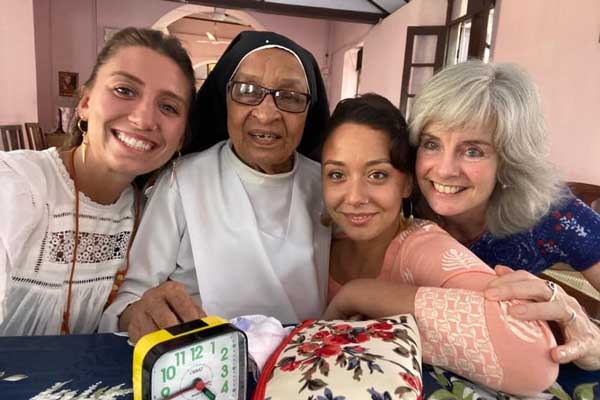
Students Paige Serpe-Miller '19, Haley Saba '18, and Professor Dempsey (left to right) pose with Sr. Mechtilde (center) in India.