Naz trio presents at statewide conference on how science class can help solve community issues
Nazareth biology, environmental science, and inclusive adolescent education major undergraduate student Josie Vandyke ’27 and recent inclusive adolescent education graduate Rachel Helfer ’26 know the importance of culture setting in the classroom —they discovered that middle and high school students want to talk about justice, and thrive when teachers give them the chance.
In their science methods class with School of Ed professor Gena Merliss, she asked them to create “culture-setting” teaching units using justice-centered, ambitious science teaching framework, based on a new framework developed by a team of researchers that included Merliss. She told her students the lesson would be used during the first two weeks of school to set a learning environment that encourages students’ sense-making, independence, and challenges the norm of traditional science by using science class to solve issues in our communities.
Merliss says the new framework supports and expands on the recent changes from New York State standards and Regents exams. “Rachel and Josie's units were so brilliant that I invited them to present at the Science Teachers Association of New York State conference in Syracuse in November,” said Merliss. “What was truly amazing was that I took a back seat in our presentation because they stepped up to present about the justice-centered ambitious science teaching framework, led a culture-setting activity, and then explained their own units. I basically set it up, and then stepped back.”
Helfer, who graduated from Naz in Dec. 2025, currently teaches middle school science in East Rochester and shared how the culture setting from her unit has helped her students engage in class.
Vandyke is student teaching middle school science with Nazareth alumnus Rob Newell at the School of the Arts in the Rochester City School District. She presented on how she’ll revise her unit based on her student teaching experience.
“Preparing for the presentation made me reflect and consider who I want to be as a teacher and what is most important,” said Vandyke. “Then, actually presenting with Gena and Rachel at the conference — I was thrilled for the opportunity to be part of something bigger than myself.”
Contact
Julie Long | Chief PR Officer | jlong2@naz.edu | (585) 389-2456 | (585) 781-8186 (cell)
Nazareth University is an inclusive community of inspired learners, educators, and changemakers who for 100 years have been driven by a bold commitment to action, empathy, equity, and leading innovation for the common good. Impact experiences are at the heart of a Nazareth education, preparing each student to discover within themselves the potential to cultivate positive change in their life's work, in any career field, and in a world that is constantly evolving and infinitely interconnected.
Our broad academic offerings present a range of study options typical of larger universities, yet achieved in our supportive campus culture. Nearly 2,100 undergrad and 600 graduate students enroll in degree and certificate programs and engage in collaborative, transformative learning experiences, preparing for the professions and society of today and tomorrow. In a learning community that purposefully integrates liberal arts and professional programs, Nazareth University graduates are able to launch a lifetime of impactful leadership in communities and workplaces near and far.
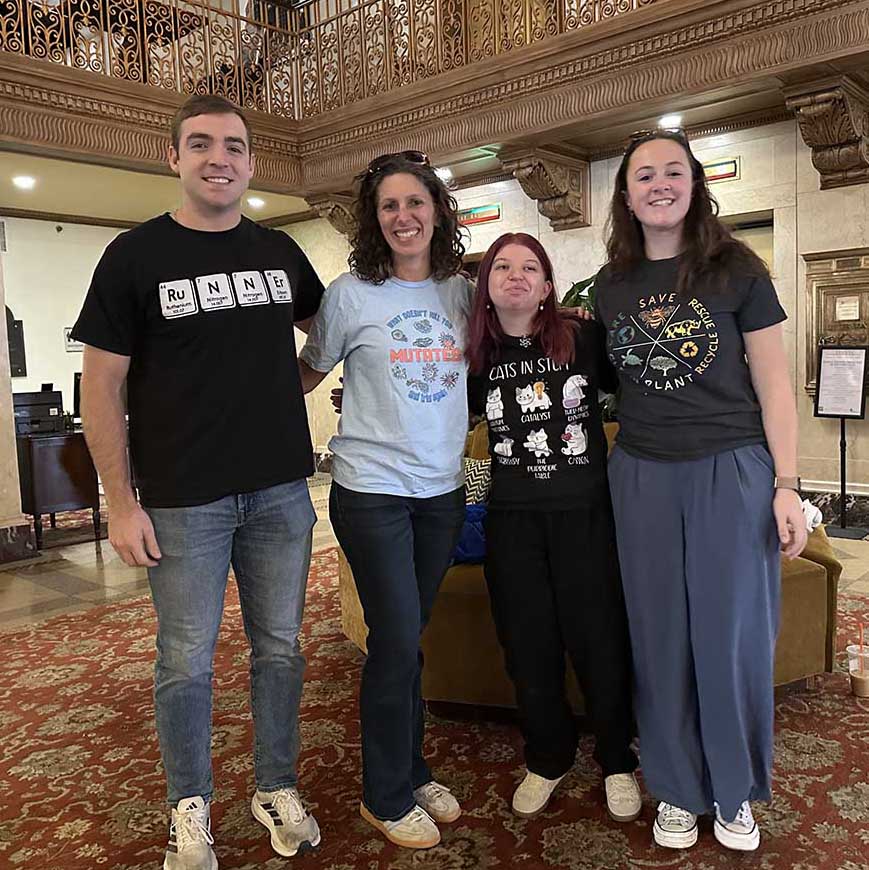
Gena Merliss, director of Nazareth’s Graduate Inclusive Education program (second from left), recently presented at the Science Teachers Association of New York State conference in Syracuse with current Naz senior Josie VanDyke ’27 (second from right) and recent grad Rachel Helfer ’26 (far right). They got a photo with Naz alum Lance Jensen ’25 (far left), whom they saw at the conference.