Mini mystery
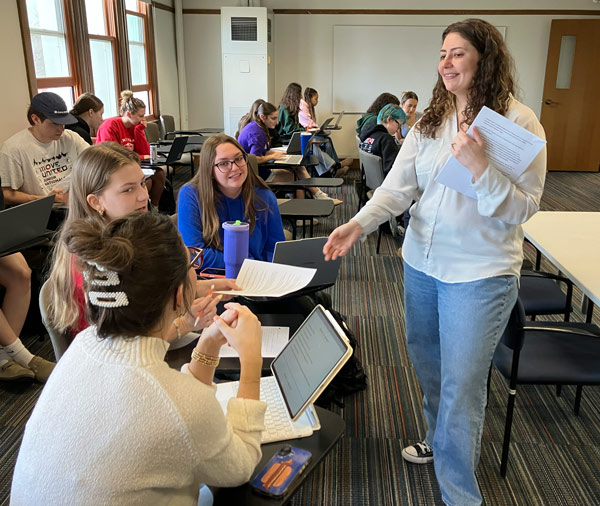
In Premodern Global History class, students work in groups on a mini mystery: Do you think King Henry II of England ordered the murder of his former best friend, the Archbishop of Canterbury Thomas Becket?
"It's a juicy, wild, breaking news murder. But it's really about church versus state power in the Middle Ages," says Alesi.
Everything has a history
I started teaching at Naz in fall 2024 and I have loved bringing classes on the history of witchcraft, Vikings, medieval food, and the environment to campus. I love telling my students about my research on animal history because people tend to be surprised that you can be a historian of animals. I think it is really exciting to show students that everything has a history and you can specialize in the most specific and interesting topics in the field of history.
What do you love about history?
I love how history can explain so much about our world today. One of the things I have always been passionate about, from a young age, is the environment and animals. As I pursued environmental and animal history, I found so many answers about why and how we got here in our relationship to the environment and its destruction.
Favorite course to teach?
I love my premodern history PEQ. While there are so many exciting classes that I get to teach, nothing beats the feeling of introducing history to someone and watching them fall in love with — or at least grow to appreciate — the subject. My courses:
- Premodern Global History (PEQ)
- Witchcraft
- Vikings
- Early Modern History
- Feast and Famine: Food in Medieval History
- Medieval World
- Ancient Greece
- Environmental Injustice
What do you like about Naz?
Nazareth has one of the best and most well-rounded history departments for a school of this size. Students can take specialized courses in all parts of history and really get an advanced educational experience.
What I have found since coming to Naz is that the students here are really passionate and ready to work. We can do a lot of exciting things in the classroom, because the students work hard and enjoy the challenge.
How do you connect history to today’s issues?
A lot of my classes are designed to help students make connections to modern issues. Whether students are making connections between witchcraft trials and social control over women and reproduction, or reading and discussing the appropriation of Viking imagery in far-right movements, the history classroom can be a place to process and understand the most prevalent issues of today.
How do you make history come alive?
A way that I engage students that is most meaningful to me is through games in the classroom. One of my biggest hobbies is Table Top Role Playing Games (TTRPGs), like Dungeons and Dragons. I started to bring these into the classroom in 2024 and now they are a regular feature in classes like Vikings and Feast and Famine. Being able to play as a character that students research, play games with one another for an assignment, and journal about the experience really increases student engagement (and fun!) in the classroom.
How do you help students prepare for meaningful lives/careers?
One of the most important things that I emphasize in my classroom is community and collaboration. Discussion in small groups and as a class are core elements in all my classes because I think, especially in our increasingly online and isolated world, the life skill of being able to express yourself verbally, work together, and build community with all different types of people is irreplaceable.
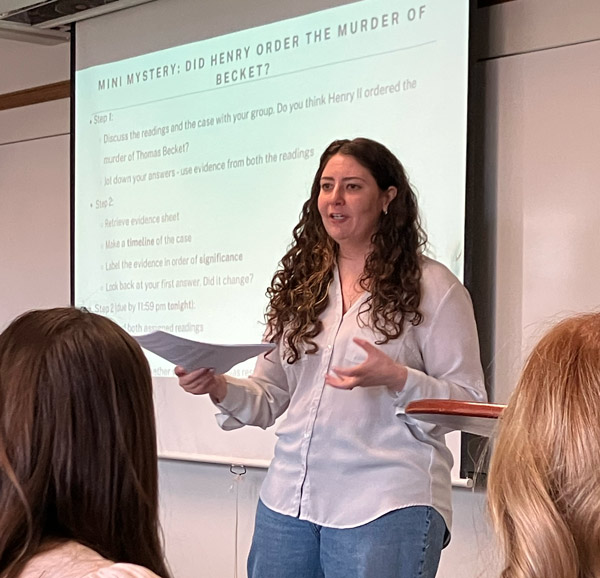
Discussion in small groups and as a class are core elements in all of Alesi's classes.
Student Perspective
“Dr. Alesi always made learning fun in the classroom. They always took extra steps to make learning an engaging and interactive experience. There were even times when Alesi created interactive TTRPGs for class assignments, where students could reenact and play out the historical experiences we were learning in the classroom. Dr. Alesi helped to foster my love of medieval history and prepared me for my success in my current program. I am a better historian because of them.”
— Kate Paulus ’25, who went on to Binghamton University for a master’s in medieval history with goals of entering a Ph.D. program.