From nine states, a community: Inside Nazareth's new physician assistant hybrid program
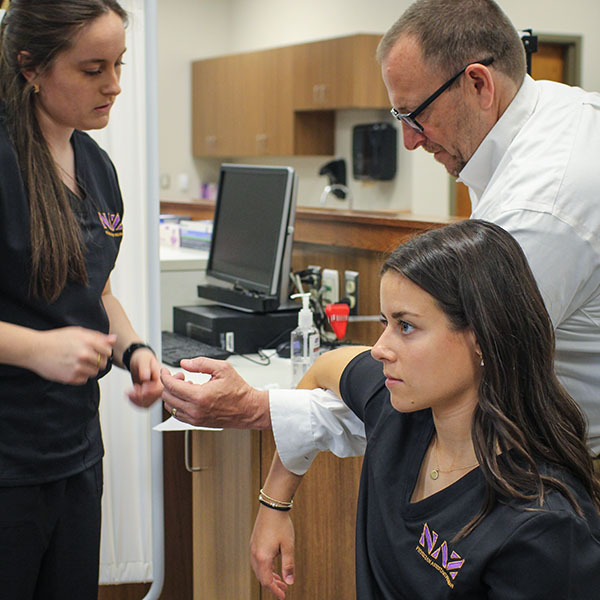
Nazareth University's first physician assistant cohort spans nine states. The graduate students come together on campus one week each semester; everything else is remote. They arrived with different backgrounds, different reasons for choosing the PA path, and different logistical puzzles to solve. What they share is a commitment to patient care and a belief that the hybrid format makes an otherwise out-of-reach degree possible.
Why Become a Physician Assistant?
For Samantha Christman, 31, the pull toward medicine has always been there. "I LOVE all things science and the human body. I like trying to piece things together, and solve whatever it is that a patient might have going on," says Christman, who lives in a small town in New York state’s North Country and wants to be a provider there. Rural communities like hers face real shortages of medical care, and she sees the PA role as a way to help close that gap. She's also drawn to the collaborative nature of the work: practicing alongside physicians, nurse practitioners, and other PAs to bring the best range of perspectives to patients.
Fatimah Al-Khafaji
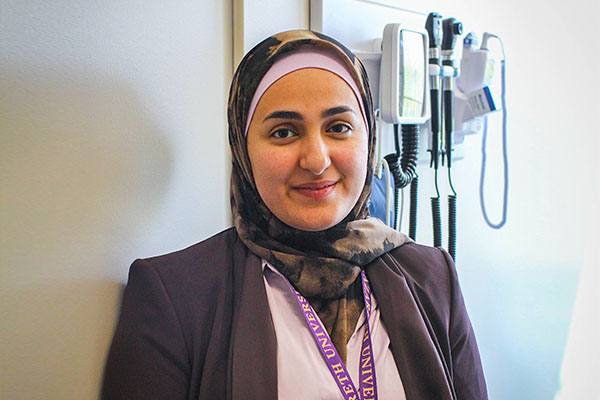
Fatimah Al-Khafaji, 25, came to medicine by a longer road. She was born in Baghdad, Iraq, and came to the United States at age 10 after her family spent two years as refugees in Turkey. Access to health care was scarce during her childhood — a reality she has never forgotten. An uncle who worked as a doctor for the U.S. Army at the American embassy gave her an early glimpse of what medicine could look like: he showed her his medical instruments and even taught her, as a 6-year-old, how to give a shot — using a banana as the practice patient. Now living in Livonia, Michigan, Al-Khafaji is motivated by the idea of providing to her future patients what wasn't always available to her. "I look forward to serving the patients, making an impact on their lives, and giving them the health care that wasn't accessible from my experience."
Konrad Juskiewicz, also 25, found his direction after nearly two years as a psychiatric technician at University of Rochester Medicine's Strong Memorial Hospital. Working with vulnerable patients — people who often felt stigmatized as well as marginalized because of their diagnoses — he developed a clear sense of the kind of provider he wanted to be. "I was always trying to make patients feel comfortable and heard, not judged," he says. "If I were a provider, this is how I'd want to be." He watched some providers approach patient care at a holistic level, going beyond the diagnosis to understand the whole person. "I could envision the kind of care I wanted to provide. It motivated me to go back to school." Juskiewicz, who grew up in Webster, New York, and studied neuroscience at Binghamton University, had long been fascinated by how the brain works — sparked in part by watching his mother, who grew up in Poland, think in Polish while speaking English at home and at work.
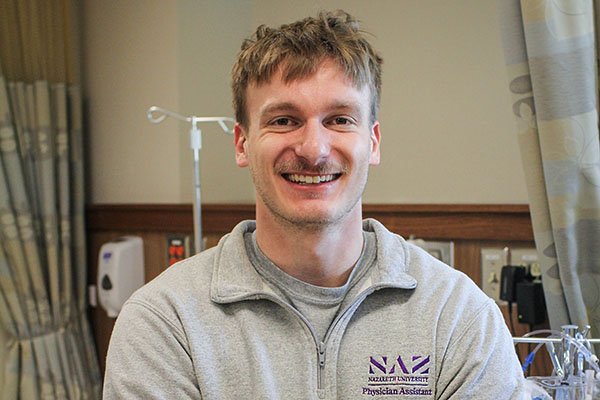
Konrad Juskiewicz
Why the Hybrid Format — and Why Nazareth?
For Christman and Al-Khafaji, the hybrid format wasn't a preference, it was the deciding factor.
"I have a home, husband, and children, and would not be able to travel back and forth regularly for classes," says Christman. "I am from an area that is very medically underserved … and not a lot of colleges/programs around." Having the option to learn remotely, with just a few in-person sessions per semester, made the program viable. She stays on campus during those visits.
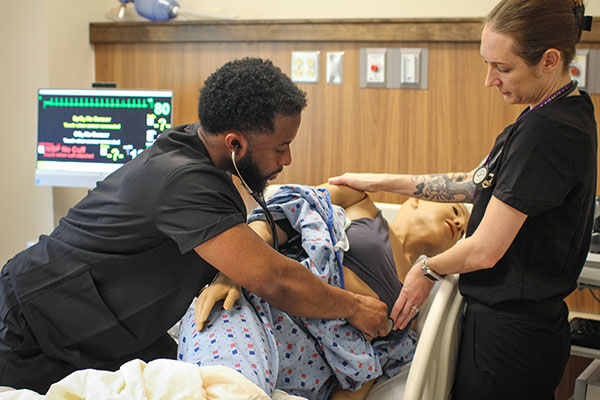
Al-Khafaji, a mother of two, similarly needed a program that would let her be present at home and balance parenting with her studies. During the short on-campus sessions, she brings her mother along to care for her baby while she attends class. "It's nice to have the hands-on experience as well, so you're getting it all."
Juskiewicz, who lives near campus, also values the flexibility. The hybrid format, he says, accommodates a changing schedule, keeps students off the road in bad weather — "no traveling in a blizzard" — and creates room for the rest of life. Between classes, he might go to the gym, see his girlfriend, or spend time with family.
What the Program Is Actually Like
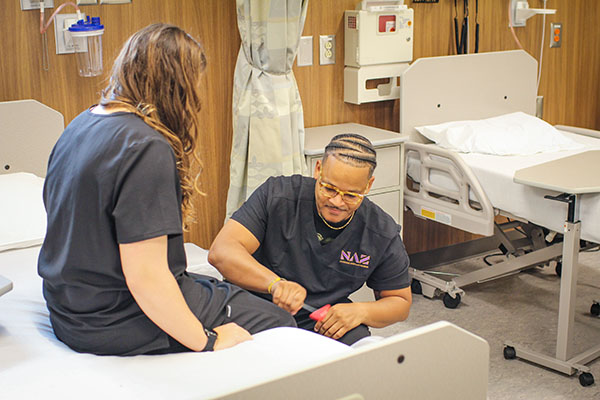
The academic pace is rigorous. Clinical medicine courses such as nephrology, dermatology, and cardiology, meet for three hours daily, from one to four weeks. Other courses are semester-long and meet one, two, or three times a week. Two exams in a single day are not unheard of. But students are quick to say the faculty support makes that workload manageable.
"One of the biggest things to me so far is how accommodating and helpful the faculty has been in terms of trying to ensure your success," says Juskiewicz. "It feels like your success is their success." During orientation, students were broken into groups of five or six, each paired with a faculty adviser — a deliberate move to make a new, hybrid program feel less anonymous. Those advisers have since checked in individually with students to ask how they're doing and what they need. "They are very receptive to student feedback," Juskiewicz says.
Christman echoes the sentiment: "The faculty are fantastic. They are all very easy to talk to, willing to help, while also holding us to high standards. The main faculty have diverse clinical backgrounds, so we get exposure to a lot of little extras."
Al-Khafaji adds that the faculty are "incredibly supportive, organized, and very adaptable" — willing to adjust when something isn't working.
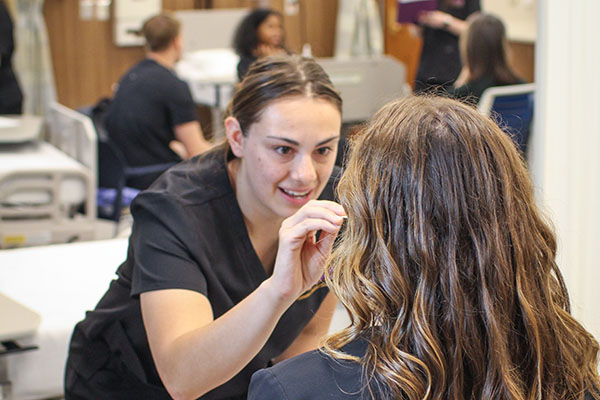
Hands-on skills are taught through video demonstrations — faculty show techniques like how to use an ophthalmoscope to examine a patient's eyes — and students practice and submit their own videos for individual feedback. Christman was surprised by how much hands-on learning is possible even from home. "Simply having one person to do exams on makes it all doable," she says, and arriving on campus for in-person sessions, she felt confident in what she'd learned.