Music Therapy
Master of Science in Creative Arts Therapy
"When words fail, music speaks." — Hans Christian Andersen
Study advanced practice, theory, and research in music therapy. Focus on individual research interests, psychotherapy, and interprofessional collaboration.
- For people with music therapy board certification (MT-BC) seeking a master's degree with psychotherapy training (48 credit hours).
- For people with non-therapy music degrees who combine the master's with an "equivalency" certificate in music therapy (60 credit hours).
- Fulfills the educational requirements to become a licensed creative arts therapist in the state of New York.
- The music therapy program is approved by the American Music Therapy Association and accredited by the National Association of Schools of Music.
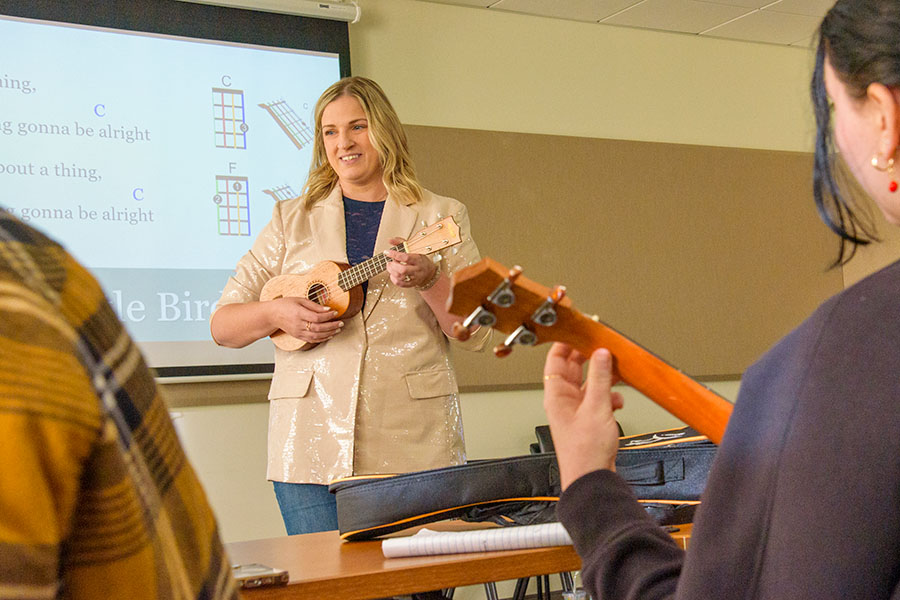
Equivalency Certificate (23 credits)
Nazareth offers a 23-credit music therapy equivalency certificate program.
Highlights

Choose full- or part-time

Clinical experience off and on campus

Complete in as fast as 2 to 2.5 years
Program Options
Master's Degree Program (48 credits)
- Program is ideal for students who already hold a bachelor's degree in music therapy or its equivalent and seek a master's degree.
- Includes the psychotherapy/counseling training required so you can apply for New York state licensure as a creative arts therapist.
- Courses are sequenced through fall, spring, and summer semesters so it's possible to complete the program in two years.
- If you are employed as a music therapist and your employer allows Nazareth to provide on-site supervision, your job can be your clinical training site; otherwise, we'll place you in a setting that matches your interests.
- FAQs about the 48-credit program.
Equivalency - Master's Program (60 credits)
- Program is ideal for musicians and music educators who want to use music therapeutically with clients.
- Program includes the psychotherapy/counseling training required so you can apply for both board-certification in music therapy and New York state licensure as a creative arts therapist.
- Courses meet during fall, spring, and summer semesters and include a 6-month full-time internship.
- FAQs about the 60-credit program.
What to Expect
- Expert faculty are all licensed mental health professionals
- Extensive interdisciplinary clinical experience off and on campus
- On-campus music therapy clinic provides stand-alone care and co-treatment with physical therapy, speech therapy, and art therapy
- Develop expertise in assessment, treatment, and professional collaboration
- Learn to work with children, adolescents, adults, and the elderly
- You have the option to include an Early intervention specialist (advanced certificate) to develop specialty knowledge and skills to be a strong advocate for young children and their families.
- Benefit from top-notch facilities. Nazareth's York Wellness and Rehabilitation Institute provides new clinic, research, and collaboration spaces. The new 550-seat Glazer Music Performance Center is designed to provide state-of-the-art acoustics for large instrumental and vocal ensembles, integrate multimedia collaborations, and enable live recording.
Why Nazareth?
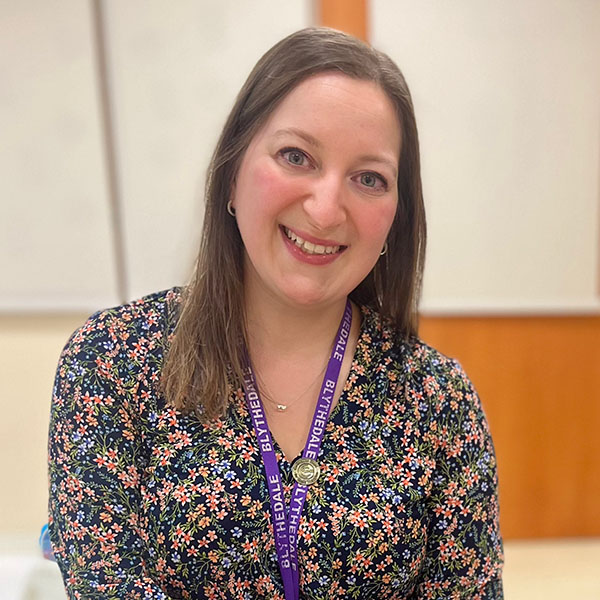
"I appreciated being taught by not only music therapists, but also art therapists, play therapists, social workers, and more. Their expertise in their craft helped me gain insight into how to work alongside other unique and creative professionals, as I do now. My graduate assistantships — in Residential Life, the Center for Spirituality, and the Creative Arts Therapy Department enabled me to learn how to work with people in all different capacities, including supporting students in a crisis and helping underserved communities thrive. My coursework directly supported my graduate assistantships and vice versa. As a music therapist, I love catering to each patient’s individual needs and goals in a creative and therapeutic framework."
— Taylor Santabarbara ‘19, ‘23G, licensed creative arts therapist (LCAT) and a Board-Certified Music Therapist (MT-BC), works primarily with infants and toddlers in a sub-acute rehabilitation hospital at Blythedale Children’s Hospital in Westchester, New York.
Value of Your Degree
Hired
Job placement is strong. Our graduates typically find employment in their chosen fields within six months after graduation.
Growth
Careers as therapists are expected to grow nearly 12% between 2023 and 2033, faster than the average for all careers.
$62,000
Average starting salary of Nazareth music therapy master's program graduates (Mean for Classes of 2025, 2024, and 2023)
Career Paths
Music therapists are employed in a variety of settings, including general and psychiatric hospitals, community mental health agencies, rehabilitation centers, treatment facilities, elder care communities, schools, and private practice.
Making Grad School Affordable
Grants, scholarships, veterans benefits, loans, and undergraduate loan forgiveness are options for paying for this grad degree.
Music and Art Therapy Co-Treatment

Music therapy intern Shannon Stott '25G and art therapy intern Melissa Gernon '99G, '24G, SSJ team up to provide their client a multi-sensory experience on the drums. The client put paint on her fingers, and as she played the drum to the beat, a picture was created.
Curriculum Examples
- Human Development and Assessment Across the Creative Arts Therapies
- Ethics and Cultural Humility
- Music & Neuroscience
- Advanced Repertoire & Improvisation in Music Therapy
- Research in Music Therapy
- Contemporary Issues in Interprofessional Team Practice