Speech-Language Pathology
Master of Science
Everyone deserves a voice.
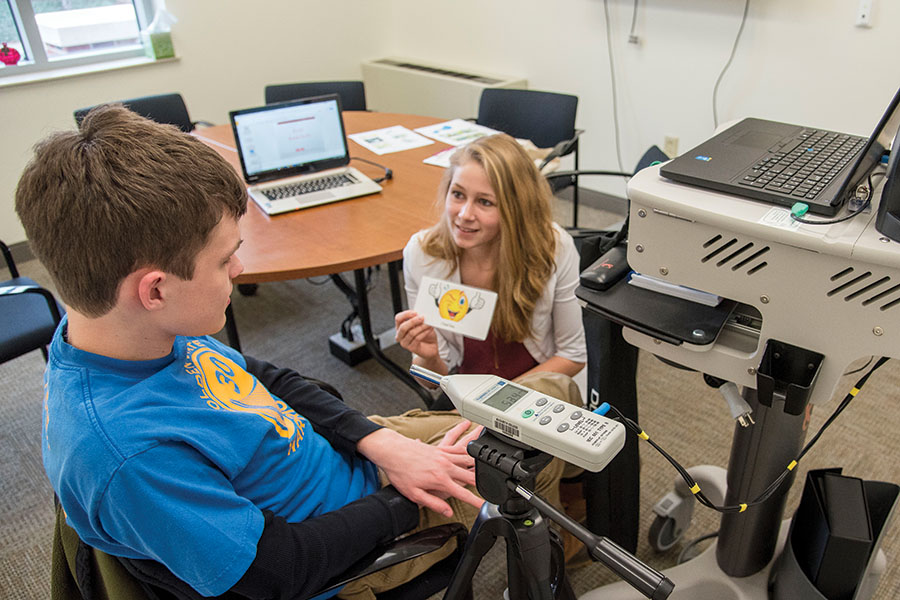
- Through coursework and extensive hands-on clinical experience, gain knowledge and skills to evaluate, treat, and advocate for people with communication and swallowing disorders.
- Opportunities for interprofessional collaboration and practicum experiences across ages, disorders, and settings.
- Individualized curriculum based on your career interests and on your educational background, to prepare you for three credentials: the American Speech-Language-Hearing Association (ASHA) Certificate of Clinical Competence (CCC-SLP), New York State license, and Teachers of Students with Speech and Language Disabilities (TSSLD) (required to work with children in preschool-21 years).
- Program is ideal for people who want to become a licensed speech-language pathologist and/or a certified New York state teacher of students with speech and language disabilities (TSSLD).
Highlights

Mix of daytime and evening classes

Complete full-time in as fast as 2 years (traditional) to 3 years (extended)

Extensive clinical opportunities on and off campus

Conduct research and present at conferences
I have an undergraduate degree in a communication science or speech-related field.
Your program:
Traditional (39 academic credits + 9 clinical credits)
- Ideal for students with an undergraduate degree in communication sciences and disorders, speech-language-hearing sciences, or equivalent.
- Can be completed in 5-6 semesters.
I do NOT have an undergraduate degree in a communication science or speech-related field.
Your program:
Extended (69 academic credits + 9 clinical credits)
- Ideal for students with a degree from another major. This option includes taking undergraduate foundational courses.
- Can be completed in 6-8 semesters.
What to Expect
- Nazareth's speech-language pathology graduate program is nationally accredited. Graduates are eligible to apply for certification by ASHA, and to apply for licensing and teacher certification by the New York State Education Department.
- Supportive, accessible faculty members are licensed, experienced as practitioners and instructors, and have a variety of research interests.
- You have the option to get specialized preparation in working with children with autism through Nazareth's Interdisciplinary Specialty Program in Autism (I-SPAN) specialization.
- You have the option to enroll in Nazareth's four-course Medical Specialization Program for preparation to work in medical settings across the continuum of health care (hospitals, skilled nursing facilities, outpatient clinics, etc.) and across the lifespan.
- You have the option to take a three-course elective sequence in the deafness specialization program.
- If you are highly proficient in Spanish, you can take three additional classes to earn a bilingual extension. Speech-language pathologists with bilingual certification are in high demand in schools across New York state.
- You have the option to include an early-intervention interprofessional concentration (track): Rochester Scholars for Early Intervention helps you develop specialty knowledge and skills to be a strong advocate for young children and their families.
- Nazareth's York Wellness and Rehabilitation Institute provides on-campus clinics, research opportunities, and inter-professional collaboration across Nazareth's College of Interprofessional Health and Human Services and School of Education.
Why Nazareth?
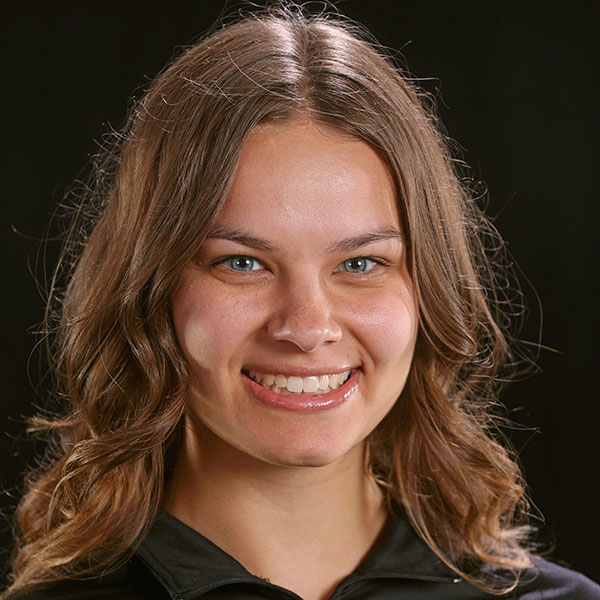
"I continued at Nazareth for my graduate program because I had strong relationships with the faculty and loved the community. The small course sizes enable faculty to know you personally and provide individual guidance, which enhanced my learning. The skills, knowledge, and clinical experiences I gained made me confident to start my clinical fellowship. This field is great because it offers many different opportunities and options throughout your career. You can work with all ages, in a wide range of settings — and will always make a difference in the lives of others. Even something small could be a massive triumph for someone, and that is what is most rewarding."
— Natalie Salewski ’22, ’23G became a medical speech-language pathologist at a skilled nursing facility through Rochester Regional Health and is a head coach for Nazareth’s Dance Team.
Value of Your Degree
96%
Our latest graduates have a 96% pass rate on the Praxis examination.
100%
Our graduates report 100% employment rates after graduation.
$92,630
Speech-Language Pathologists on average earn $92,630, U.S. Bureau of Labor Statistics (2023).
Starting salaries: During the fellowship year after graduation (when salaries are lower), Nazareth speech-language pathology graduates earned an average of $66,000 (Classes of 2025, 2024, and 2023).
Making Grad School Affordable
Grants, scholarships, veterans benefits, loans, and undergraduate loan forgiveness are options for paying for this grad degree. Are you committed to teaching in high-needs schools? See if you are eligible for the Teacher Opportunity Corps II (TOC II) Scholarship.

The Master of Science (M.S.) in speech-language pathology (residential) at Nazareth University is accredited by the Council on Academic Accreditation in Audiology and Speech-Language Pathology of the American Speech-Language-Hearing Association, 2200 Research Boulevard, #310, Rockville, MD 20850, 800-498-2071 or 301-296-5700.
Program Director

Alumni Spotlight
"A strength of Nazareth's program is that the professors care about the students' success. I could walk down the hall with a question, pop into any office, and have an answer in seconds. I would be greeted with kindness and enthusiasm for the field of speech-language pathology, without any judgment or hostility. The difference between a program where the teachers want you to succeed and a program where they couldn't care less if you are there is happiness — the happiness you feel walking into your clinical placement... sitting down in a three-hour lecture ... walking across the stage ... and the happiness you feel when you get to say you are finally an SLP, and that it was all worth it."
— Anna Guinan '20, '24G, who went on to a clinical fellowship year at an elementary school