Germany & Poland: The March: Bearing Witness to Hope
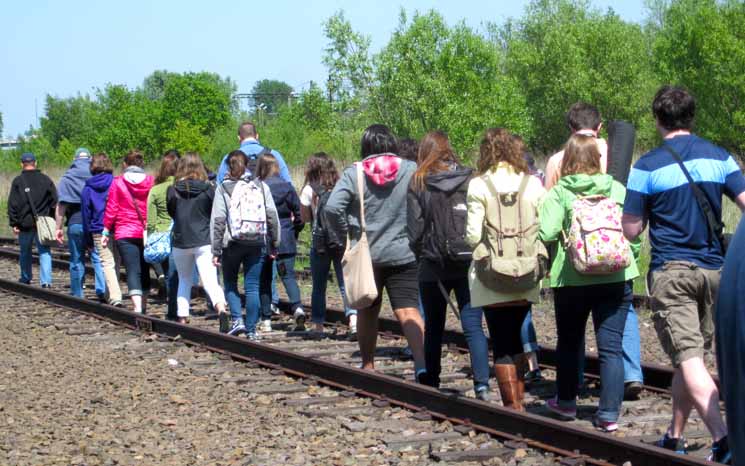
Travel to Germany and Poland to study the Holocaust under the collective guidance of Holocaust scholars, survivors, and Israeli and Polish guides. On this trip, you visit cities that were once vibrant Jewish communities, concentration and death camps engineered by the Third Reich, and historic locations commemorating acts of resistance and rescue in the face of the "final solution." Participants commit to identify, confront, and transform situations of prejudice, bigotry, and intolerance, institutionally as well as inter-personally. Faculty and staff mentors work with students to confront the ethical dilemmas, political implications, and religious questions raised by the Holocaust today.
2025 Reflection
"Through my lens: Bearing witness to hope on Holocaust education trip" — Matthew Roberson '26
SPARK GRANT:
Qualifying freshman, sophomore, and transfer students can use their SPARK Grant for this short-term study abroad program.
Making the trip accessible
In 2015, the Max and Marian Farash Charitable Foundation granted Nazareth and Hobart and William Smith Colleges endowments totaling $500,000 to offset the cost for students to participate in The March.
In 2017, friends of Nazareth, Dr. E. David and Barbara Appelbaum, established the Barbara G. Appelbaum Holocaust Education Award, an endowed fund designed to support Nazareth students committed to Holocaust awareness who are interested in participating in The March.
We are grateful to the Farash Foundation and the Appelbaums for affording our students opportunities to learn about the Holocaust in the places where it happened and to identify, confront, and transform situations of prejudice, bigotry, and intolerance, both institutionally and personally upon their return.
Documenting Evil
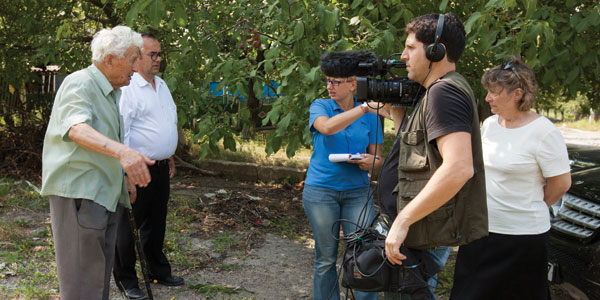
Nazareth students, faculty, and staff take part in the recording and documenting of Holocaust survivors testimonies. Read more.
Kara Miller read this essay at a Yom Hashoah (Holocaust Memorial Day) service after going on The March.
It never stopped raining. We were there for nine days. It never stopped. To me it seems like it has been raining for the past 70 years.
If you’re ever walked a thousand miles through hell, you know that it can only be described as the foulest place on earth; a place where the air is so acrid with the burden of sin that breathing is nearly impossible. Fortunately I walked through this hell with friends, with people I now call family. We are the group who participated in the March of Remembrance and Hope. I cannot adequately tell you our story in five or six minutes. I think I can safely say that for most of us, it may take a lifetime to explain every emotion, every twist of the stomach, every cry.
We were nothing more than a group of college students the first time we stepped off the bus. We were all individuals searching for something far away. We were apprehensive to a t, journeying far away from our families. We would question our decisions a thousand times over as we moved from camp to camp, our feet dragging aimlessly. We went as individuals and came back as large pieces of each other. We carried a piece of everyone’s heart in our own. Some of us cried everyday, others of us thought in silence. Nowadays, some of us sing, others write. Though we all carried different loads on our back, the weight always felt the same. It came to a point where even if we weren’t crying on the outside, we were always crying on the inside. We never had to ask each other what was wrong, we just always knew.
You may say, well why you? You guys are so young, so vibrant. Why would you ever voluntarily put yourselves in such places? I can only say that when you’re young, you haven’t always seen a lot of the world. When you experience something like standing among the railway lines at Birkenau, or walking through the Wannsee house creaking Hitler’s floorboards, you begin to see the world differently. The little things don’t seem to matter as much because looming in the back of your mind is something much bigger; something far worse than that which is trite and cheap.
I think it is safe to say we were a vibrant group. We sought hope in the farthest corners of concentration camps. We were always looking for that light at the end of the tunnel. And at the end of the day, when every ounce of energy we had was gone, when every bit of happiness should have been stripped from our bodies, we found solace in each other. We took comfort in the fact that we could be a generation to make a difference; a generation of storytellers. It was sad for us to imagine the generation of holocaust survivors leaving us, but we felt it was our destiny to follow behind them. To say, "I am here so your story will never die".
Our trip was one of contemplation. We saw and we thought, and then we thought and saw a little more. We spent hours discussing how it was humanly possible for anyone to commit such atrocities. We could never come up with an acceptable answer. But somewhere in all that discussing we realized it was not our goal to find an answer that would justify the final solution. It was our goal to be survivors for a nation of survivors. To be a group of voices that could live on for years.
It was painful to see so much destruction, and so much that still stood. It was painful to know that there are people that live in the backyards of Majdanek, and there are gas stations and car dealerships across from Plaszow. There are street cats that roam the barracks of Auschwitz. It is nothing but surreal. In a moment of feeling so lost, feeling as though time has stopped, you look around and you see nothing but life. It was as if to say, yes, life does go on, but you can never forget the past.
Till that point, I had lived my entire life believing I was whole. The world I lived in was cookie cutter shaped like the one’s my mother pulls out during holidays. I lived for the love my parents gave me, and the charm of my friends. But I never appreciated my life until I realized how many people there who were never got to experience their own lives. There were parents who never got to see their children grow up; there were children who never got to dance alongside imagination; there were simple and extraordinary human beings ripped out of their lives, who never got to see a world of change and hope.
I realized at that moment, that to be scared, to never want to learn about the Holocaust, would be a disservice to every individual who perished or survived. My generation, a generation of seers, was the next generation of the resistance movement. The holocaust would teach us to never remain silent. Never let those that may have been bigger than us tread on us. If I wanted the Holocaust to be understood I would have to wholeheartedly become a freedom fighter for the knowledge movement. We were truly the next generation. I would have to take decades of interviews, photographs, histories, and stand up within my movement and say, "we have to learn from the past to define our future. If you do not care to learn, we may not make it out alive. How we live and learn my friends is up to us." We are the voices of those who died, we are the revolution, we are the reason a Holocaust of this magnitude will never happen again.
You cannot leave these places unchanged. From the stones of Treblinka to the faces of Plaszow, you can hear voices; voices crippled by a raging war sought against them. If you listen you can hear their voices in the trees that still breathe life, that were probably there when madness was played out beneath them. All you can do is keep listening. Keep listening and surviving and living your life for the people that couldn’t. That is what my MRH family and I seek to do everyday. We commit ourselves to the deceased and the living. We commit ourselves to a future of hope.
At A Glance
Term: Summer A 2028
Program Level: Undergraduate & Graduate Students
Program Types: Experiential Learning
Major(s): Open to all majors, and of particular interest to the following majors:
- Anthropology
- Education
- International & Global Studies
- History
- Legal Studies
- Museums, Archives & Public History
- Political Science
- Psychology
- Religious Studies
- Sociology
Language Requirement: None
Minimum GPA Requirement: 2.5